

All the news, right? 😉
As I write this blog article, I am reminded of the potential energy behind composing a narrative that evokes feelings and then is jettisoned into the community only to be scathed by the naysayers and applauded by the “believers”.
Context, in a world of digital mediums, is being attacked. We don’t really take the time, or have the time, to research on our own anymore. We find ourselves limiting our social and informative interactions to quips of large stories, provided in flashes of light from our mobile devices, creating a fractured sense of the things going on.
And WORSE…it’s perpetuated by advertising.
Yup, I said it.
Sensationalism is the original sin used to manipulate us into spending more time or money on things the message purports; no matter our true interests or principles.
It’s Content Strategy Gone Awry
I believe that because our societies and independent cultural norms of small regions (tribes) are now connecting to larger multi-hub and spoke models bridged by technology, the telephone game we’ve found ourselves in is now at its zenith. And oh what a time for the owners of “truth”; whoever we think they may be.
To tap into the belief system and “feelings” of a group of people and convince them to make a decision or believe a certain idea without much data is the quintessential diagram of conversion rates for most advertising companies. It is the paradigm in which we strive to deliver a formula of where we find the customer, convince them they need this new widget and they can’t live without it. So, they make the purchase possibly racking up credit card debt buying the service or product they may not be able to afford.
Or worse, they, or “we”, inherit the sensational advertising story used to sell widgets or get votes and now it is what we believe to be true; despite our own core principles.
In a recent book, there was information uncovering a larger aspect of where my industry had become known for a particular type of manipulation that exacerbated negative economic issues. In Weapons of Math Destruction, Kathy O’Neil has a fantastic love affair with data and her experience with mutual fund data leads her into digital marketing for big, big companies. From her account, she** credits marketing algorithms and demographic targeting tools for keeping people poor** by promoting debt products to impoverished on-lookers. Her clients were successful…so, she was successful, right?
While companies don’t exist without marketing/advertising, new technology and tools need to also bring new responsibilities.
Counterbalance of the Consumer Mentality
So - is it all bad? I think we are still too early to tell. But I think it’s a tough realization and I think we can take on some of this responsibility ourselves.
Once upon a time, we had to take turns talking in full sentences. We remarked about our recent experiences of the past periods of time where we didn’t hear from one another for quite some time. The conversations were rich and we anticipated these events and sought after them for our own social divulgence.
Now, with technology, we no longer find ourselves in orator-style conversations with our full attention. We abruptly bumble through our ideas with friends as if we’re attuned to swiping right through each conversation showing disinterest until we find the chemical connection to something that feeds our newly trained non-contextual belief system.
It’s tough finding a good conversation these days…right? We can do much better by finding our own moderation points and avoid the moment we become clinically diagnosed with a benign disinterest in our own lives and suddenly become enamoured with everyone else’s sensational life they share on Facebook.
Facebook and PolitiFact Score Big With Me
When the tides of blue and red, black and white, female and male bring so many stories to the shore we need to find the ways and means of every word. We’ve lost our desire to seek the truth. And we’ve empowered every podcaster and blogger to carry on by very carelessly clicking a share button and qualifying the message with our recommendation. Very few people can decipher this interaction and see the underlying mission of the source.
Whether it be CNN or Fox News, they sell ads, not “NEWS” and they know their advertiser’s products very well. Simple. And they “create” their consumer just like I do for our clients. Don’t know about product A or service B? Well, we change that. We put it into your face and provide context that puts the need into your life.
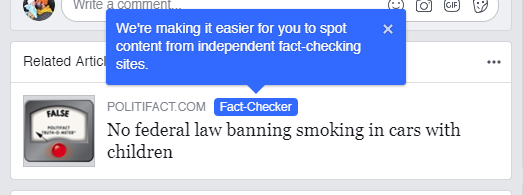
So, when I saw today that Facebook has now added an ‘icon’ to news posted on it’s New’s Feed, I felt like a new entity of the digital realm was born. Not a policy-driven organization bent on destroying the news…**but an attempt at destroying the sensationalism around truth used to sell advertising. **
[
](https://www.poynter.org/international-fact-checking-network-fact-checkers-code-principles)
And I am all for it.
We should not bend the truth about products and services, but it will continue to happen. We shouldn’t share stories we’ve heard via unchecked blogs from leftists, liberals, or conservatives, but we will want to. I am up for someone making money off the lack of our desire, or time, to discover the truth and push for a solid binary principle that facts exist and are obtainable.
So, take it from me, a well-trained, experienced manipulator, eh hmm…I mean “content strategist”. There is a new cultural standard on its way to securing the sanctity of context and truth, giving power and resolution to an old caste of humans; the truthists. (Those who practice or are concerned with the truth.)
Read more here: The International Fact-Checking Network (IFCN) at Poynter is committed to promoting excellence in fact-checking. Third-party fact-checkers investigate stories in a journalistic process meant to result in establishing the truth or falsity of the story.